
Coming to a Tiny Airport Near You:New Airlines
6 Jul, 2026
Avelo Airlines and Breeze Airways have found success and loyal customers byserving airports in smaller cities, like New Haven, Conn., that were neglected bynational carriers.
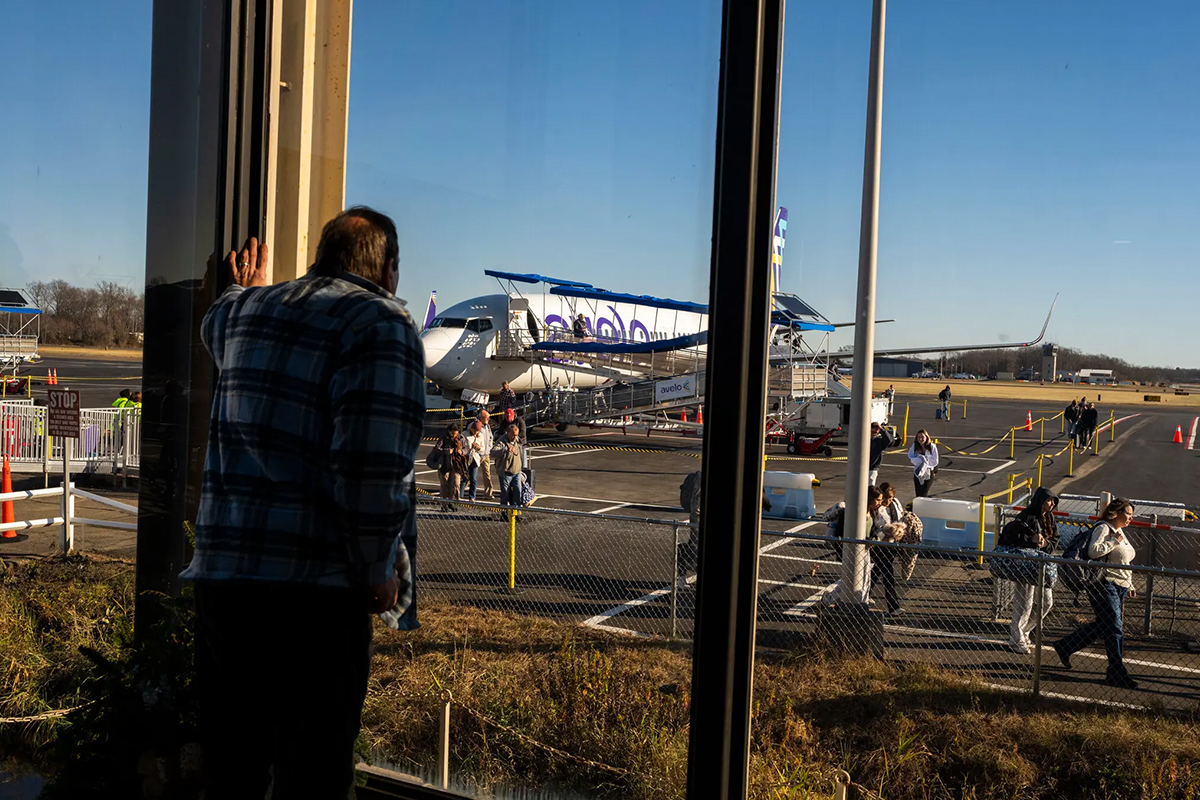
One cold Thursday afternoon this month, the small airport in New Haven, Conn.,was bustling.
A line of cars stretched from the terminal, down the main road and into aneighborhood. Inside the airport, a new, second-floor bar was crowded aspassengers on the floor below walked through a gate into one of three waitingplanes.
Five years ago, Tweed-New Haven Airport would have been much quieter. Backthen, it hosted about a half-dozen daily flights, mostly short American Airlinesjaunts to and from Philadelphia. This month, about 30 flights a day wereconnecting the airport to more than two dozen destinations.
The revitalization of this airport, which sits close to Long Island Sound, is aconsequence of long-running industry changes that created an opportunity for a pair of start-up airlines — Avelo Airlines and Breeze Airways — to fly from airportsthat the country’s biggest carriers have largely neglected.
“What we’re really seeing here is the next generation of industry structure andevolution,” said John Strong, a business professor at William & Mary who focuseson the airline industry.
Aviation is unforgiving. Competition is fierce, the barriers to entry are high andsuccess is fragile. After decades of consolidation, four large airlines control two-thirds of domestic air travel. Most of their flights take off or land at large airports,which has made their operations efficient and generally profitable. But over time,the big airlines trimmed service at smaller airports.

Avelo has reported profits for several quarters.
That created an opening for Avelo and Breeze. Both started flying in the spring of2021, with networks and planes suited to underused airports. The airlines mainlyfly nonstop between destinations, often providing direct service where noneexisted before. That differs from the hub-and-spoke model favored by larger airlines, which route flights from smaller airports through big, central hubs incities like Atlanta, Chicago and Dallas. Avelo and Breeze also fly small- to medium-size planes with plenty of seats, but not so many that the two airlines mightregularly struggle to fill them.
“It’s just about the economics,” Lukas Johnson, the chief commercial officer atBreeze, said. “You’re kind of Goldilocks. You’re the right size, for the right model,for the right price and efficiency. And that’s really where we’ve carved out a niche.”
The big question is: Can Avelo and Breeze sustain their growth? The history ofairlines is littered with bankruptcies and failures. Profits on routes betweensmaller airports can be modest, and demand can disappear quickly duringrecessions or when costs of fuel or labor rise and airlines increase ticket prices oradjust service.
Industry experts say that for now, the two airlines, which are privately owned,appear to be doing well. Both have earned loyal followings and have kept costs lowand service reliable.
Breeze reported its first monthly profit this year and aims to be profitable for all of2025. Avelo has reported several quarterly profits, and its chief executive, AndrewLevy, said he expected the airline to break even this year — or be close to doing so— with over $300 million in revenue.
“It’s not about what kind of food am I getting or what’s the lounge like,” he said.“What really matters is give me a good deal and just get me there on time. And weexcel at that.”
Breeze and Avelo are broadly similar. Both mainly serve people traveling for fun orto visit family and friends. They often fly routes that few or no other airlinesoperate on — for example, from New Haven, Avelo flies to cities like Knoxville,Tenn., and San Juan, P.R., while Breeze offers flights between Erie, Pa., andOrlando, Fla.; Hartford, Conn.; and Wilmington, N.C.
Both companies were also founded by industry veterans — Breeze by DavidNeeleman, the entrepreneur behind JetBlue Airways, and Avelo by Mr. Levy, aformer top executive at United Airlines and Allegiant Air.
But the airlines are also different in some ways. Avelo offers cheap fares and fewperks. There are no change or cancellation fees, but also no Wi-Fi, power outlets,snacks or drinks for sale. Breeze offers more choice, including options that tap intothe growing demand for premium travel after the pandemic, with different seatingclasses, name-brand snacks and drinks, Wi-Fi, and power outlets. Avelo flies anolder generation of the Boeing 737, while Breeze is moving to a fleet entirely madeup of the Airbus A220, a smaller jet.
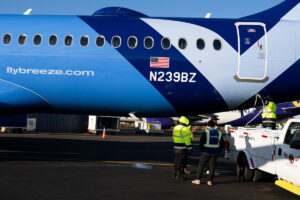
Avelo flies an older generation of the Boeing 737, while Breeze is moving to a fleet entirely made up ofthe smaller Airbus A220.
And despite their budding rivalry in New Haven, where Avelo is dominant, theairlines hardly compete head to head. Avelo mainly operates up and down the Eastand West Coasts. Breeze has twice as many flights, including some across thecountry, according to Cirium, an aviation data firm that tracks flight schedules.Together, the airlines flew about 325 routes this year, but competed on only eight.
“They both have a unique product, a different product,” said Michael Boyd, anaviation consultant with the Boyd Group International. Still, he added: “The headoffices of those two companies probably aren’t exchanging holiday cards.”
Avelo and Breeze have given hope to some airports and cities that have lost flightsin recent years. American Airlines, which did not respond to a request forcomment, pulled out of Tweed in late 2021, leaving the airport with no commercialairline until Avelo arrived a few weeks later.
“Almost every day, I have a conversation with some resident who’s excited thatthey could visit their relatives or go on a weekend trip to Florida,” said MayorJustin Elicker of New Haven.
The airport and the two airlines support hundreds of local jobs, and the flights haveincreased tourism and connected New Haven’s thriving life sciences sector, whichhas strong ties to Yale University, with other cities that have similar hubs, he said.
For Mia Whitfield, the benefits have been personal. She flies Avelo frequently fromNashville to New Haven to visit her boyfriend, who recently moved to the area. Shehas taken more than a half-dozen Avelo flights between the cities this year, savinghours on trips from other airlines that require connecting flights and long drivesfrom airports in Hartford or Providence, R.I.
“It’s no-frills, but it’s what you need it to be,” Ms. Whitfield said. “We’re just reallygrateful to have the option. It gives us more time together at the end of the day.”
The airport’s small size makes it easy to quickly get in, move through security andonto your flight, she said. But there are drawbacks: The one-room arrival terminalcan get crowded quickly, and traffic can get backed up during peak times, she said.
The traffic, noise and other environmental concerns have frustrated someresidents. City and airport officials say they are working on ways to spread outtraffic, and the airlines have avoided flying early and late in the day.

Breeze and Avelo both appear to be doing well for now, analysts say. “It’s no-frills, but it’s what you needit to be,” one frequent flier on Avelo said.
Community members and neighboring East Haven, on whose land the airport alsosits, have taken issue with plans to extend the airport’s runways and build a newterminal. Save the Sound, an environmental nonprofit, recently asked a federalcourt to require the Federal Aviation Administration to rework an analysis of theenvironmental impact of the new terminal, citing concerns that it would negativelyaffect air quality, flooding and noise.
“There are huge environmental consequences, and they really failed tomeaningfully explore these,” said Roger Reynolds, the nonprofit’s senior legaldirector.
But proponents of the terminal, which the F.A.A. has approved, said it would helpto better handle the influx of traffic, people and flights. Jorge Roberts, the chiefexecutive of AvPorts, which is building that terminal and runs the existing one in aconverted hangar, said the effort had been underway since he visited the airportbefore the pandemic.
“I said, ‘You have a gold mine here,’” he said. “The data is showing us there’s anunderserved market.”
Avelo, which flies from 54 airports, says it has served more than 2.8 millionpassengers out of New Haven. Tweed was home to more than one in five scheduledAvelo flights this year, according to Cirium data. That’s twice as many as the airlineflew from its second-largest hub, Hollywood Burbank Airport near Los Angeles.
Breeze serves 66 airports, including some near New Haven. It connects Hartfordto more than two dozen destinations, and flies from Providence as well as LongIsland and White Plains in New York. The airline will operate only a few dozenflights in New Haven in December, but plans to fly a few dozen a week in February.
Analysts say there is room for both companies in the airline industry, though theycould be vulnerable if the economy suffers a sharp downturn.
“It depends on how spending changes,” Mr. Boyd said. “When discretionary dollarsgo away, discretionary flying goes away.”
Go to News List page to check more news...
News List